
Blogs
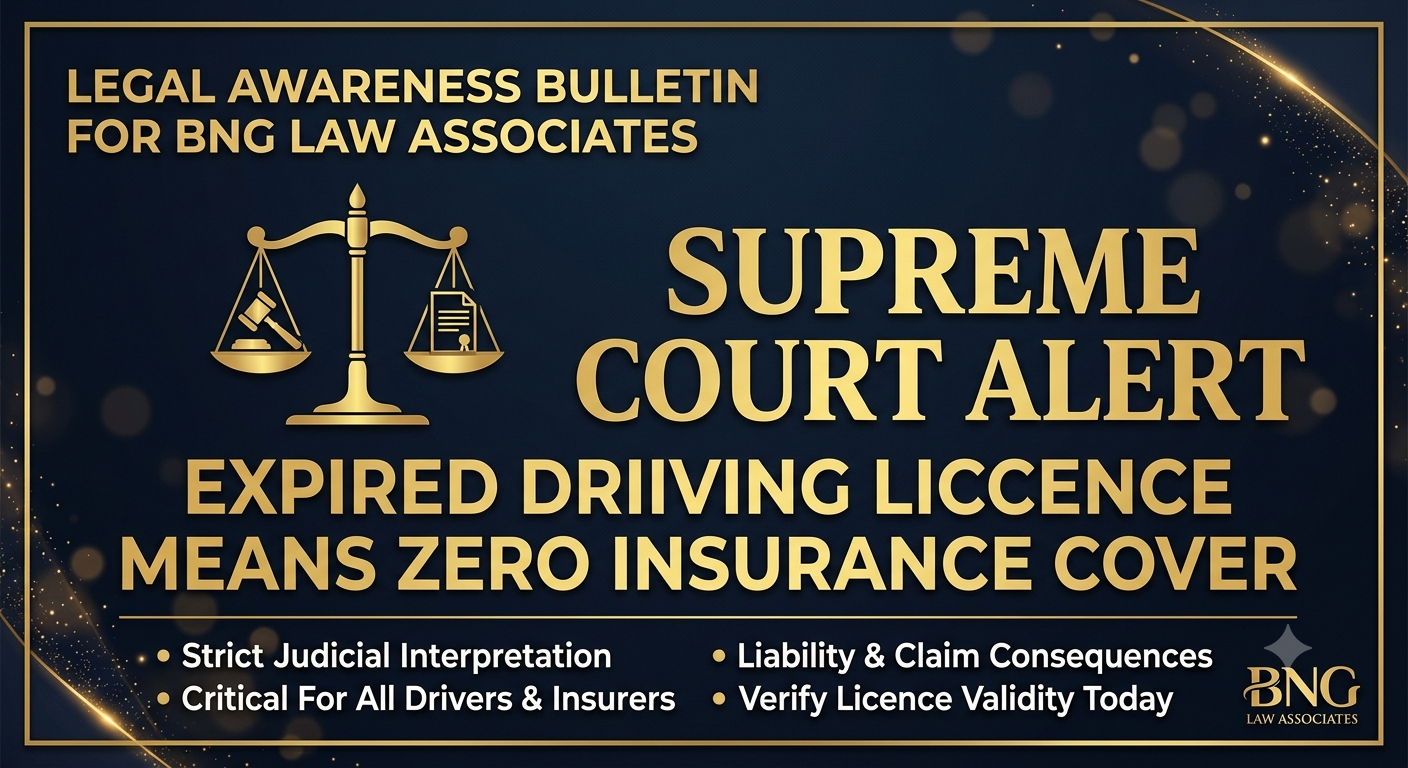
Supreme Court 2026 Verdict: Expired Driving Licences, Insurer Absolution & Personal Liability of Vehicle Owners
Supreme Court 2026 Verdict: Expired Driving Licences, Insurer Absolution & Personal Liability of Vehicle Owners
By BNG Law Associates | Legal Awareness Series In a landmark decision shaping motor accident claims, corporate fleet management, and insurance indemnification, the Hon’ble Supreme Court of India in Reliance General Insurance Co. Ltd. v. Om Parkash & Ors. (2026 LiveLaw (SC) 742) reaffirmed a critical statutory principle under the Motor Vehicles Act, 1988: An insurance company cannot be held liable to indemnify a motor accident claim if the driver lacked a valid, subsisting driving licence due to non-renewal at the time of the incident. For high-net-worth individuals, commercial fleet operators, corporate entities, and Non-Resident Indians (NRIs) holding vehicle assets in India, this ruling highlights severe financial and operational exposure that demands immediate risk management. 1. Key Findings of the Apex Court A Division Bench of the Supreme Court of India (Bench of Hon'ble Mr. Justice Sanjay Karol and Hon'ble Mr. Justice Nongmeikapam Kotiswar Singh) examined the scope of insurer liability when a vehicle is operated on a public road without a valid driving licence. The Court laid down three pivotal determinations: Absolution of Insurer Liability: When a driver operates a motor vehicle with an expired licence beyond the statutory grace period for renewal, it constitutes a fundamental breach of policy conditions and statutory mandates under Section 149 (or the corresponding provisions under Section 150 of the Motor Vehicles Act, 1988 as amended). The insurer is completely absolved of its contractual obligation to indemnify the insured vehicle owner. Personal Financial Burden on Owner and Driver: The primary obligation to pay third-party compensation or property damage claims falls squarely on the vehicle owner and the driver. Even in scenarios where the Court invokes the "pay and recover" principle—directing the insurance company to pay the third-party victim initially—the insurer retains an absolute legal right to recover 100% of the awarded compensation directly from the vehicle owner. Call for National Awareness & Renewal Streamlining: Recognizing that gaps in licence renewal often stem from administrative oversight rather than deliberate non-compliance, the Apex Court urged the Ministry of Road Transport & Highways (MoRTH) to implement nationwide awareness drives and automated renewal notification frameworks to protect vehicle owners from catastrophic financial liabilities. 2. Impact on Corporate Fleets, HNI Owners & NRI Asset Holders The operational implications of this judgment are far-reaching for commercial enterprises and overseas property/vehicle managers: Corporate Fleet Exposure: Commercial entities managing logistics, corporate transport, or executive vehicle fleets in Delhi NCR and across India face strict vicarious liability. Allowing an employee or commercial driver with an expired licence to operate a company vehicle exposes the firm to uncapped personal injury and third-party property damage claims. NRI Property & Asset Management: Non-Resident Indians (NRIs) who maintain vehicles in India—often managed through local Power of Attorney (PoA) holders, family members, or personal drivers—face direct execution proceedings against their Indian real estate and bank accounts if an uninsured accident claim arises due to a driver's lapsed licence. 3. Strategic Risk Management Framework by BNG Law Associates To safeguard corporate entities and high-net-worth individuals against unindemnified claims, BNG Law Associates recommends implementing the following compliance protocol: Automated Licence & Policy Audits: Establish periodic digital audits for all personal and corporate drivers to verify licence validity, class authorizations, and endorsement renewals. Contractual Indemnity Clauses: Incorporate explicit compliance warranties in commercial driver contracts and logistics vendor agreements, stipulating personal indemnity in the event of licence invalidity. Execution & Decree Protection: For NRIs facing third-party recovery notices or execution petitions in Indian courts, immediate legal intervention is required to contest pay-and-recover orders or protect real estate assets from attachment under Order XXI of the Code of Civil Procedure (CPC). About BNG Law Associates With over 15 years of advocacy excellence, BNG Law Associates is a premier law firm based in Delhi NCR, providing panel-grade strategic legal solutions across Corporate Litigation, Commercial Risk Advisory, Real Estate Disputes, and NRI Asset Protection. For strategic consultations, corporate fleet risk audits, or representation in High Courts and the Supreme Court of India: 🌐 Website: www.bnglawassociates.com 💻 NRI & Corporate Virtual Legal Desk: Available via Zoom & Microsoft Teams